

Introduction to Real-Time Web Communication
The evolution of the web from static document delivery to dynamic, interactive applications has necessitated a shift in how clients and servers communicate. In the early days of the internet, the Request-Response model was sufficient: a user clicked a link, the browser requested a page, and the server sent it back. However, modern applications, ranging from live stock tickers and social media feeds to collaborative editing tools and multiplayer games, require data to be pushed from the server to the client instantly. Achieving this 'real-time' feel involves several different architectural patterns, each with its own trade-offs in terms of latency, scalability, and complexity.
Traditional HTTP Polling
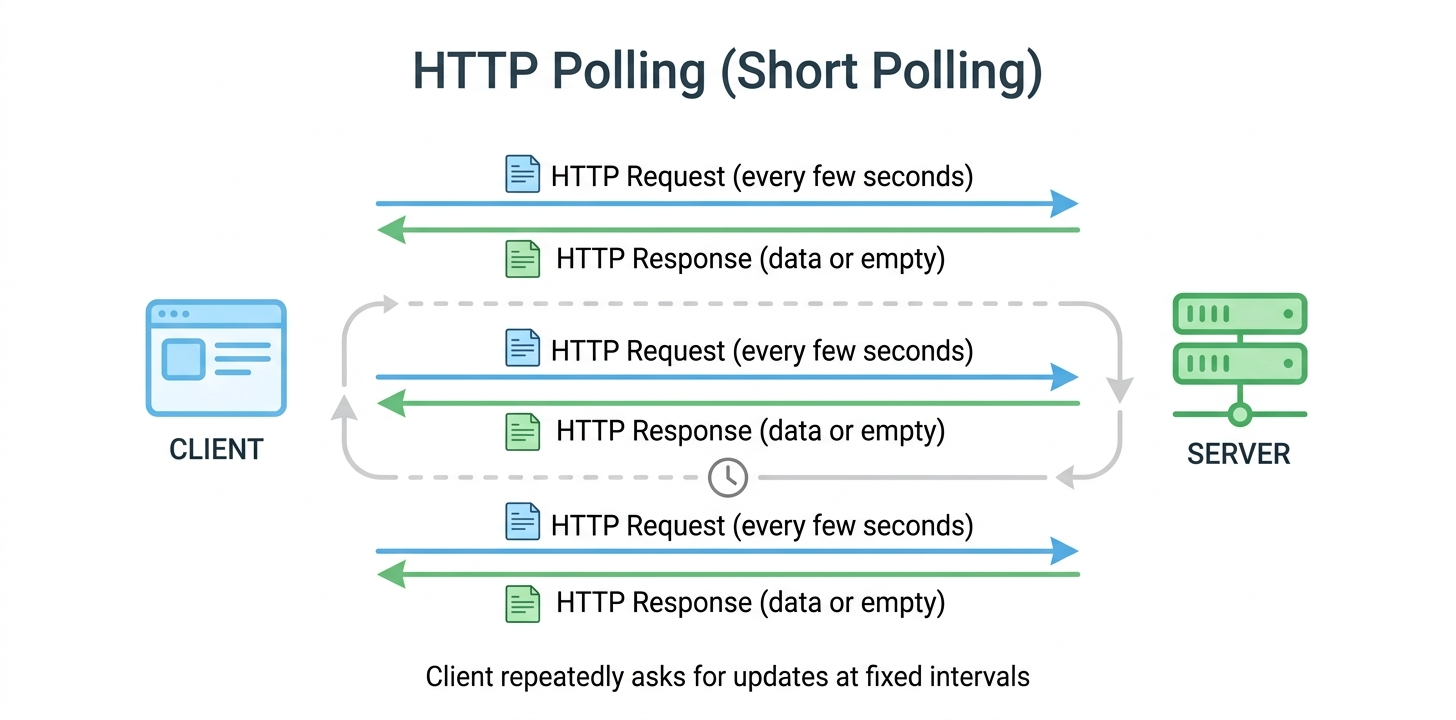
Traditional HTTP Polling, often referred to as 'Short Polling,' is the simplest way to simulate real-time updates. In this model, the client periodically sends an HTTP request to the server at a fixed interval (e.g., every 5 or 10 seconds) to check if there is any new data available. The server immediately responds with the data if it exists, or an empty response if nothing has changed since the last request.
Advantages and Disadvantages
- Pros: Extremely easy to implement on both the client and server side; works with any standard HTTP server; no special protocols or persistent connections required.
- Cons: High overhead due to repeated HTTP headers; inefficient use of bandwidth; creates unnecessary server load during periods of no data changes; introduces latency (data is only as fresh as the polling interval).
Use Cases
Traditional polling is best suited for applications where data doesn't change frequently and where a delay of a few seconds is perfectly acceptable. Examples include checking the status of a long-running background job (like a video export) or refreshing a weather widget that only updates hourly.
HTTP Long Polling
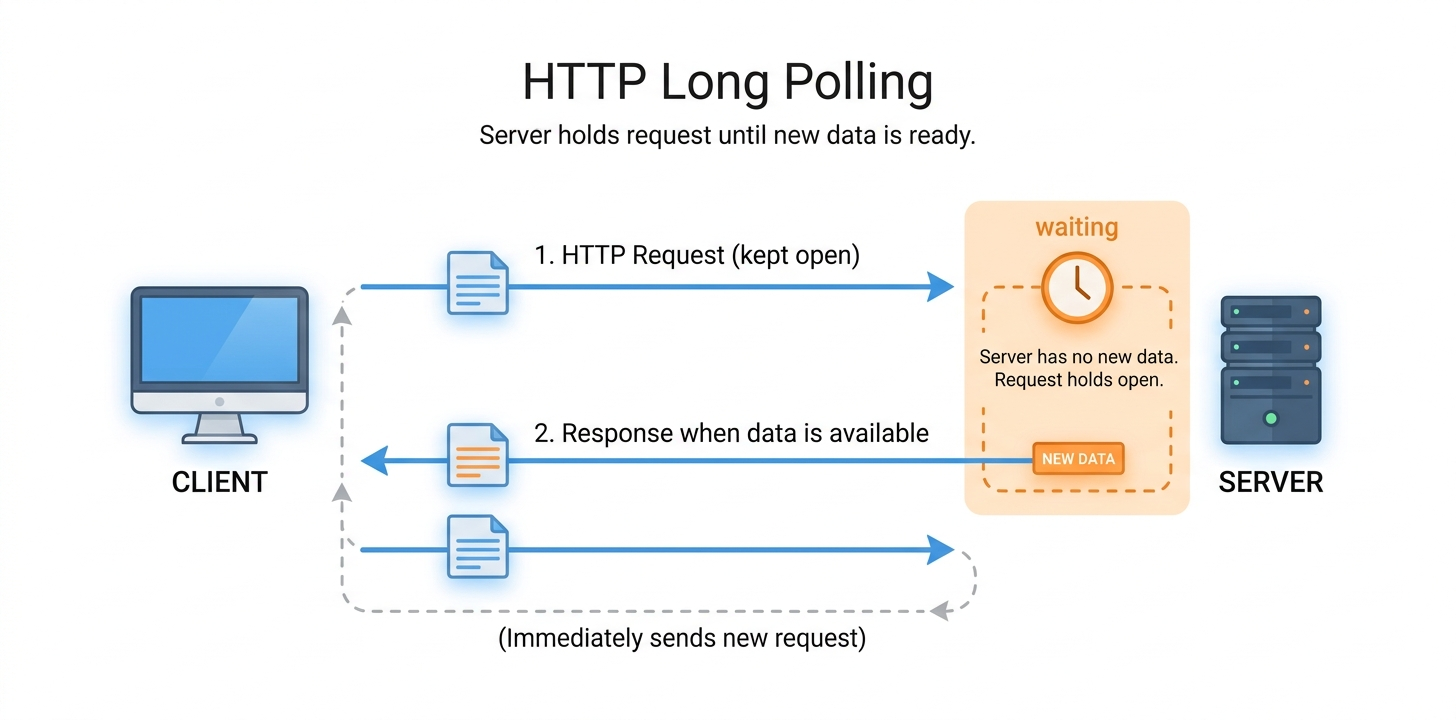
Long Polling is a more sophisticated variation of traditional polling designed to reduce the number of empty responses and minimize latency. In this model, the client sends a request to the server, but instead of responding immediately, the server holds the request open until new data becomes available or a timeout occurs. Once the client receives a response, it immediately sends another request, creating a 'loop' that keeps a request pending most of the time.
Advantages and Disadvantages
- Pros: Much lower latency than short polling; reduces the total number of requests sent when data is infrequent; works over standard HTTP/HTTPS.
- Cons: Still involves the overhead of HTTP headers for every message; can lead to 'Thundering Herd' problems where many clients reconnect simultaneously; requires more complex server-side logic to manage hanging connections.
Use Cases
Long polling was the standard for real-time web chat (like the original Facebook Chat) before WebSockets became widely supported. It is still a valid fallback mechanism for environments that block non-HTTP protocols or for simple notification systems.
Server-Sent Events (SSE)
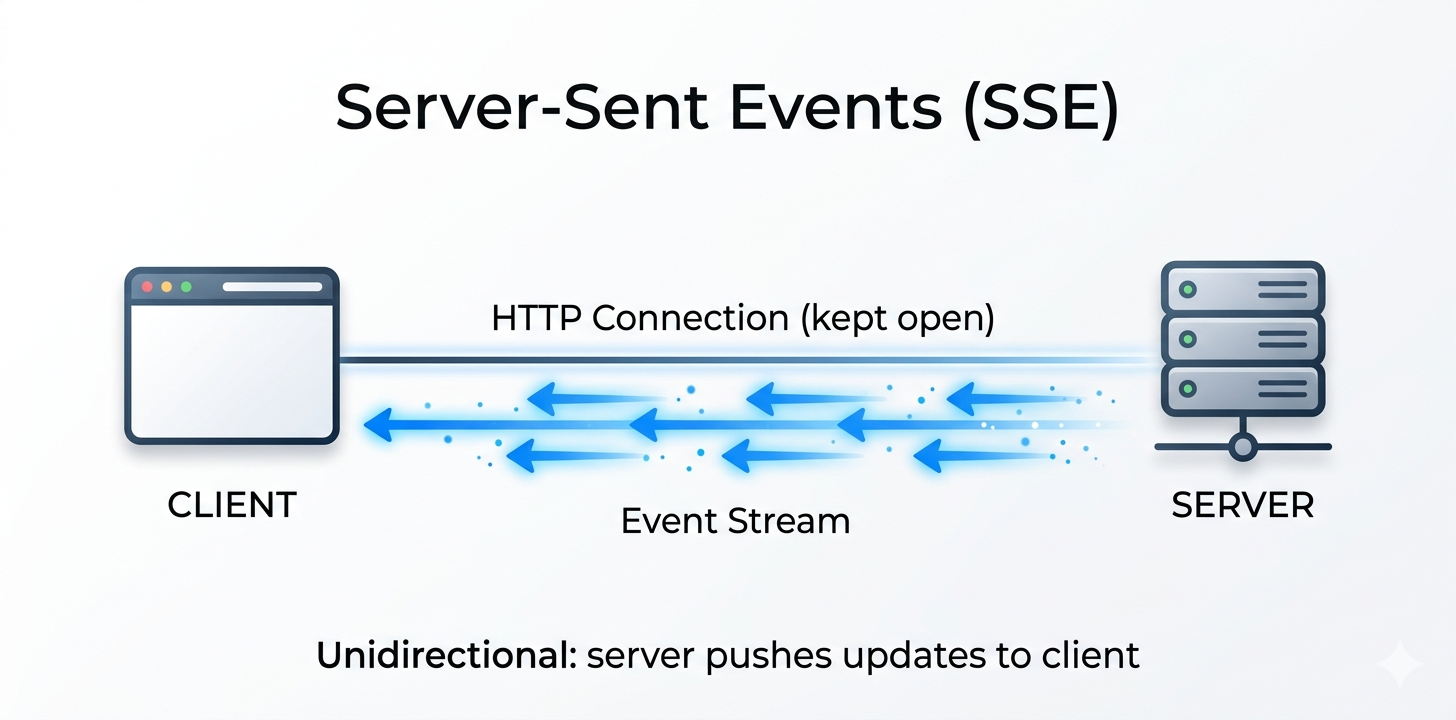
Server-Sent Events (SSE) is a standard allowing servers to push data to web pages over HTTP. Unlike polling, SSE establishes a single, long-lived connection. The server keeps this connection open and sends 'events' to the client as they happen. It is a unidirectional protocol, meaning data flows only from the server to the client.
Advantages and Disadvantages
- Pros: Very lightweight compared to WebSockets; built-in support for automatic reconnection; works over standard HTTP (easier for firewalls and proxies); supports custom event types.
- Cons: Unidirectional only (client cannot send data back over the same stream); browser connection limits (traditionally 6 per domain on HTTP/1.1); text-based format only (though binary can be Base64 encoded).
Use Cases
SSE is perfect for scenarios where the client needs constant updates but doesn't need to send frequent messages back to the server. Examples include live sports scores, stock market dashboards, social media news feeds, and system monitoring consoles.
WebSockets
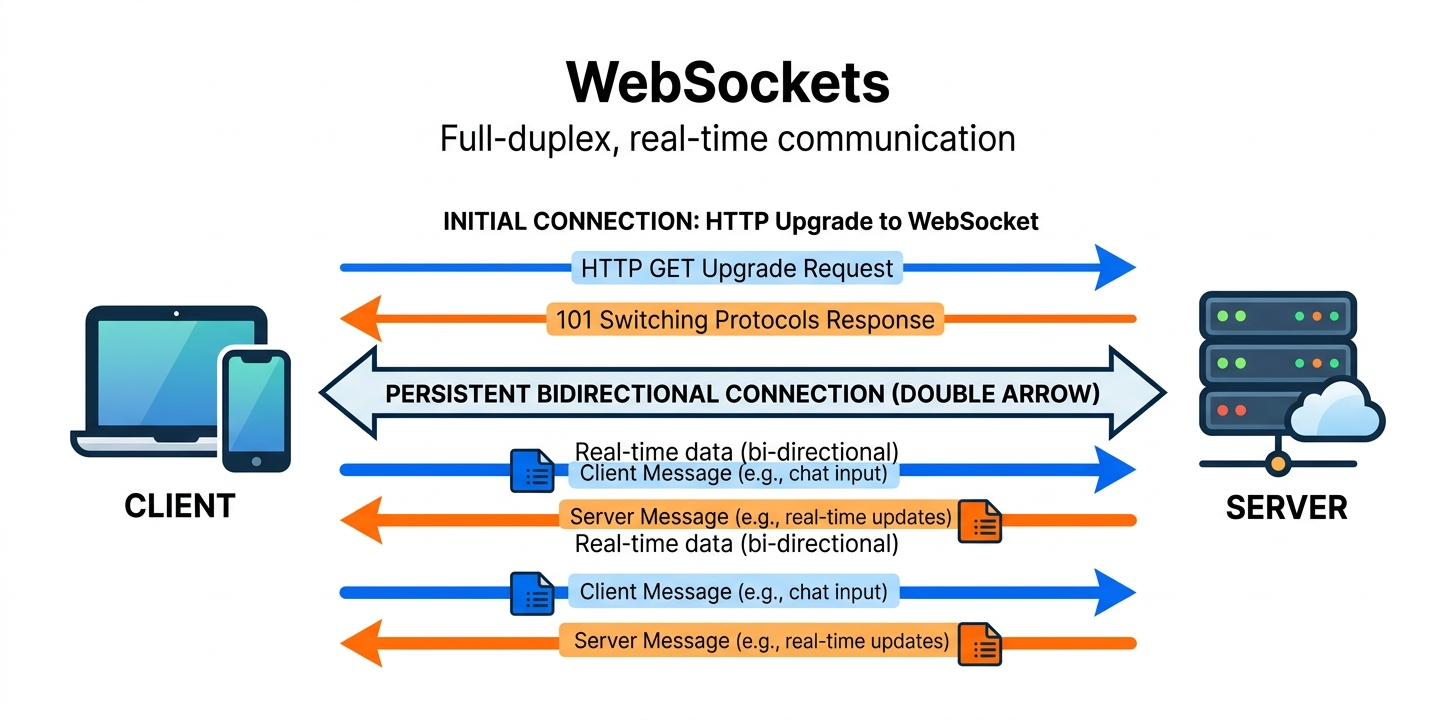
WebSockets provide a full-duplex, bidirectional communication channel over a single, long-lived TCP connection. The connection starts as an HTTP request with an 'Upgrade' header. Once the handshake is successful, the protocol switches from HTTP to the WebSocket protocol (ws:// or wss://). This allows both the client and the server to send data at any time without the overhead of HTTP headers.
Advantages and Disadvantages
- Pros: Real-time, low-latency bidirectional communication; minimal per-message overhead (small frames); handles binary and text data efficiently; ideal for high-frequency updates.
- Cons: More complex to implement and scale (requires stateful servers); not compatible with some older proxy servers or firewalls; no built-in automatic reconnection mechanism (must be handled by the developer).
Use Cases
WebSockets are the gold standard for interactive applications where latency is critical. This includes multiplayer gaming, collaborative editing (like Google Docs), high-frequency financial trading platforms, and feature-rich instant messaging apps.
The Ultimate Decision Guide: When to Use What
Choosing the right technology depends heavily on your application's requirements for latency, frequency of updates, and the direction of data flow. Here is a quick reference guide:
- Use Traditional Polling if: You are building a simple prototype, or the data updates very infrequently (minutes apart), and you want to avoid server complexity.
- Use Long Polling if: You need better latency than short polling but must support environments where WebSockets or SSE are blocked, or if your server infrastructure is strictly request-based.
- Use Server-Sent Events (SSE) if: You need a lightweight, efficient way to push data to the client (one-way), you want native reconnection handling, and you are working with standard HTTP infrastructure.
- Use WebSockets if: You require true bidirectional, low-latency communication where both the client and server can send data simultaneously at high frequencies.
Pro Tip: If you are using HTTP/2, the limitations on the number of SSE connections are largely mitigated through multiplexing, making SSE an even more attractive option for many dashboard-style applications.
Conclusion
Understanding the nuances between polling, long polling, SSE, and WebSockets is essential for building performant modern web applications. While WebSockets often get the most attention for their power and flexibility, they are not always the most efficient choice for every problem. By evaluating your specific needs, whether it is the simplicity of polling, the robustness of SSE for streams, or the raw speed of WebSockets for interactive sessions, you can ensure a better experience for your users and a more maintainable architecture for your developers.