
The Python Web Framework Landscape
Python has solidified its position as one of the most versatile and popular programming languages in the world. Much of its success in the web development domain can be attributed to its robust ecosystem of frameworks. For years, Django was the undisputed king of Python web development, providing a comprehensive, 'batteries-included' approach that allowed developers to build complex applications rapidly. However, as the industry shifted toward microservices, real-time applications, and high-performance APIs, new contenders emerged. FastAPI, a modern, high-performance framework based on standard Python type hints, has quickly become the primary alternative to Django.
Choosing between Django and FastAPI is not a matter of which framework is 'better' in an absolute sense, but rather which one is better suited for a specific project's requirements. Django offers a structured, monolithic environment that handles everything from database migrations to user authentication out of the box. FastAPI, on the other hand, focuses on speed, minimalism, and the power of asynchronous programming. Understanding the nuances between these two requires a deep dive into their architecture, performance, and developer experience.
Django: The Batteries-Included Powerhouse
Django was released in 2005 with a clear philosophy: 'The web framework for perfectionists with deadlines.' It follows a 'batteries-included' approach, meaning it comes with almost everything a developer needs to build a full-stack application without relying heavily on third-party libraries.
Key Features of Django
- Object-Relational Mapper (ORM): Django’s ORM is one of its strongest features, allowing developers to interact with databases using Python code instead of SQL. It handles complex queries, migrations, and relationships with ease.
- Admin Interface: Automatically generated from your models, the Django Admin is a production-ready tool for managing application data without writing a single line of frontend code.
- Security: Django is designed to protect developers from common security mistakes, such as SQL injection, cross-site scripting (XSS), and cross-site request forgery (CSRF).
- Authentication: It includes a robust user authentication system that handles sessions, cookies, and permissions out of the box.
Django is traditionally a synchronous framework (WSGI), though it has recently introduced asynchronous support (ASGI). However, its core ecosystem including the ORM is still predominantly synchronous, which can be a limitation for high-concurrency, I/O-bound applications.
FastAPI: The Modern Speedster
FastAPI was created by Tiangolo (Sebastián Ramírez) and released in 2018. It was built to leverage modern Python features like type hints and the 'async' and 'await' keywords. Built on top of Starlette (for web parts) and Pydantic (for data parts), FastAPI is designed to be incredibly fast, both in terms of execution speed and developer productivity.
Key Features of FastAPI
- Performance: FastAPI is one of the fastest Python frameworks available, rivaling Node.js and Go in some benchmarks, thanks to its asynchronous nature.
- Automatic Documentation: Using OpenAPI standards, FastAPI automatically generates interactive API documentation (Swagger UI and ReDoc) based on your code and type hints.
- Data Validation: By using Pydantic, FastAPI ensures that incoming data matches your defined schemas, providing clear error messages when validation fails.
- Asynchronous Support: It is native to ASGI, making it ideal for handling thousands of concurrent connections, WebSockets, and long-lived requests.
Core Differences: Architecture and Philosophy
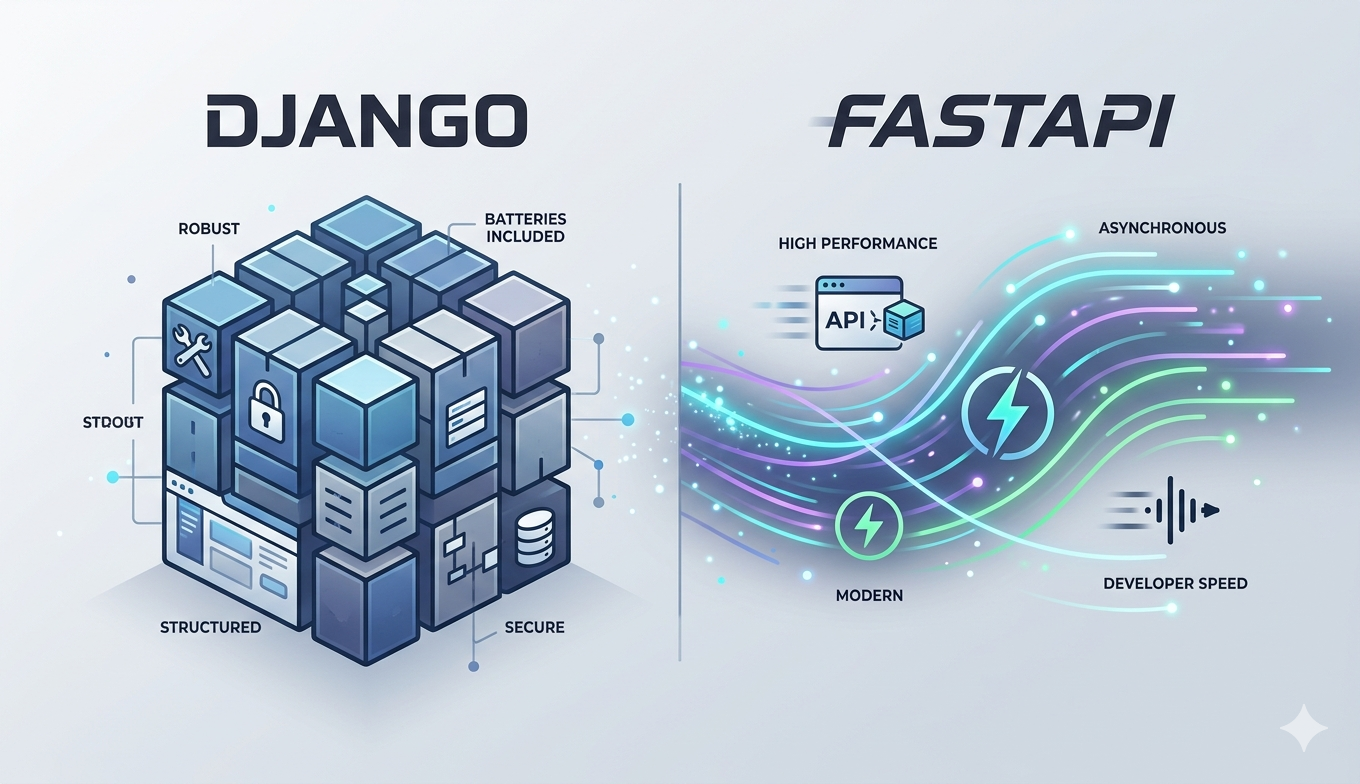
The most significant difference between the two lies in their architectural philosophy. Django is a 'Monolithic' framework. It assumes you want a complete package and provides a strict directory structure and set of rules. This 'opinionated' nature is great for teams because it ensures consistency across projects.
FastAPI is a 'Micro' framework. It provides the essentials but leaves the choice of database, ORM (like SQLAlchemy or Tortoise), and project structure to the developer. This flexibility is powerful but requires more decision-making and manual setup. While Django provides an Admin UI and an ORM, FastAPI requires you to integrate these yourself if you need them.
Django is like a fully furnished house; FastAPI is like a high-end architectural kit where you design the layout and pick the furniture yourself.
Comparing Scenarios: When to Use Which?
Scenario 1: Building a Content Management System (CMS) or E-commerce Site
In this scenario, Django is the clear winner. Applications like a CMS or an e-commerce platform require user management, complex database relationships, an admin dashboard for staff, and robust security. Django provides all of these out of the box. For example, if you are building an online store, you can use Django’s built-in authentication for customers, its ORM to manage products and orders, and its Admin panel to manage inventory.
Scenario 2: High-Performance Microservices and Machine Learning APIs
If you are building a microservice that needs to handle thousands of requests per second or serving a Machine Learning model, FastAPI is the better choice. Machine learning models often involve I/O-bound tasks (like calling other services) or heavy data processing. FastAPI’s asynchronous capabilities allow it to handle multiple requests without blocking. Furthermore, the automatic Swagger documentation is invaluable for internal teams consuming your microservices.
Scenario 3: Rapid Prototyping for a Full-Stack MVP
When you need to get a Minimum Viable Product (MVP) to market quickly, Django’s speed of development is hard to beat. Because it handles the database setup, user registration, and admin panel automatically, you can focus entirely on your unique business logic. You don't have to spend time debating which library to use for authentication or how to structure your folders.
Scenario 4: Real-time Applications and WebSockets
For applications that require real-time updates, such as a chat application or a live sports ticker, FastAPI is superior. While Django can handle WebSockets using Django Channels, it adds significant complexity to the stack. FastAPI handles WebSockets natively and efficiently, making it the more lightweight and performant choice for real-time data streaming.
The Learning Curve and Ecosystem
Django has a steeper initial learning curve because there is so much to learn, the ORM, the template engine, the settings file, and the specific way Django handles requests. However, once you learn the 'Django way,' you can be incredibly productive. The community is massive, and for almost any problem you encounter, there is a 'django-something' package that solves it.
FastAPI is much easier to pick up initially, especially if you already know modern Python and type hints. You can write a functional API in just five lines of code. However, as the project grows, the complexity shifts from learning the framework to making architectural decisions. You have to decide how to handle database sessions, how to structure your dependency injection, and how to manage migrations (usually using Alembic).
Conclusion: Which One Should You Choose?
The decision between Django and FastAPI ultimately depends on the nature of your project and your team's experience. Use Django if you are building a data-driven, full-stack application with a lot of 'standard' features like users and an admin panel, or if you want a proven, stable framework for a large enterprise project. Its monolithic nature provides a safety net and a standard that makes it easy for new developers to jump into the project.
Use FastAPI if performance is your top priority, if you are building a microservice-oriented architecture, or if you are creating a backend for a frontend framework like React or Vue. Its modern approach to Python makes it a joy to work with, and its speed ensures that your application remains responsive even under high load. By understanding the strengths of both, you can leverage the best of what Python has to offer for your specific web development needs.